Minesweeper guide
How to Play Minesweeper: Rules and Patterns
Minesweeper is a deduction game, not a speed-clicking game. Every revealed number describes its eight neighboring squares, and overlapping clues turn hidden mines into a logic problem you can solve.
Play Minesweeper free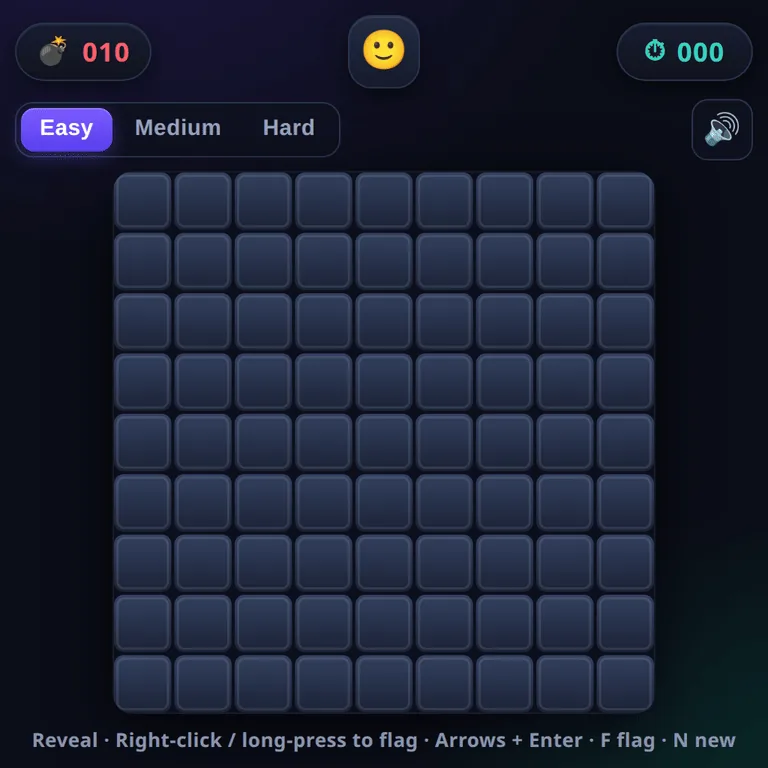
What the numbers mean
A revealed number tells you exactly how many mines touch that square horizontally, vertically, or diagonally. A 1 has one neighboring mine; a 3 has three. Empty squares have no adjacent mines and usually open a larger safe area automatically.
You win when every non-mine square is revealed. Flags are optional markers for your reasoning—they help you track mines, but placing a flag does not make an incorrect square safe.
Start with a guaranteed safe opening
In Arcadely’s Minesweeper, mines are placed after the first reveal. The opening square and its neighbors are protected, so the first move cannot hit a mine and normally exposes enough information to begin solving.
Choose a central opening when you want clues in several directions. An edge opening can be simpler to read, but it reveals information across a smaller part of the board.
The two rules behind every deduction
Nearly every Minesweeper pattern reduces to two checks. First: if a number already touches the required number of flagged mines, all its other covered neighbors are safe. Second: if the number of remaining covered neighbors equals the number of mines still required, all of those neighbors are mines.
- Satisfied clue: required mines are already flagged, so reveal the other neighbors.
- Full clue: every remaining covered neighbor must be a mine, so flag them.
- Overlap: compare two nearby clues and subtract what they share.
How the 1–2–1 pattern works
When three clues along a straight boundary read 1–2–1 and the covered squares form one row beside them, the mines sit beside the two outer 1s. The square beside the central 2 is safe. The mirrored totals force that arrangement.
Do not memorize the shape without checking its boundary. Extra covered neighbors around one of the clues can change the deduction. A pattern is valid only when the clues refer to the exact candidate squares you are comparing.
Use flags carefully
Flag a square when the clues prove it contains a mine, not merely because it looks suspicious. After flagging, revisit every adjacent number. One confirmed mine often satisfies several clues and opens a chain of safe reveals.
Arcadely supports right-click to flag on desktop and long-press on touch screens. Keyboard players can move the focus with arrow keys, reveal with Enter, and flag with F.
What to do when the board feels stuck
Scan the entire exposed boundary before guessing. A quiet clue on the opposite side may resolve the crowded area. Compare pairs of clues that share most of their covered neighbors; the difference between their mine counts is often the missing fact.
Some Minesweeper layouts can eventually force a probability choice. If no deduction remains, choose the square constrained by the fewest possible mine arrangements rather than clicking an isolated unknown at random.
Easy, medium, and hard boards
Arcadely offers a 9×9 easy board with 10 mines, a 13×13 medium board with 28 mines, and a 16×16 hard board with 45 mines. Learn the two basic rules on easy, then move up when you can solve boundaries without repeatedly recounting every flag.
Common questions
Can the first click be a mine?
No. Arcadely places mines after your first reveal and protects that square and its immediate neighbors.
Do I need to flag every mine to win?
No. The board is complete when all safe squares are revealed. Accurate flags simply make the deductions easier to track.
What does chording mean in Minesweeper?
Chording reveals the remaining covered neighbors of a numbered square after the correct number of adjacent flags has been placed. Use it only when those flags are certain.