2048 guide
2048 Strategy Guide: How to Reach 2048
2048 looks like a game of lucky tile spawns, but most runs are decided by board structure. A repeatable corner strategy gives every new tile a job and keeps your largest numbers close enough to merge.
Play 2048 free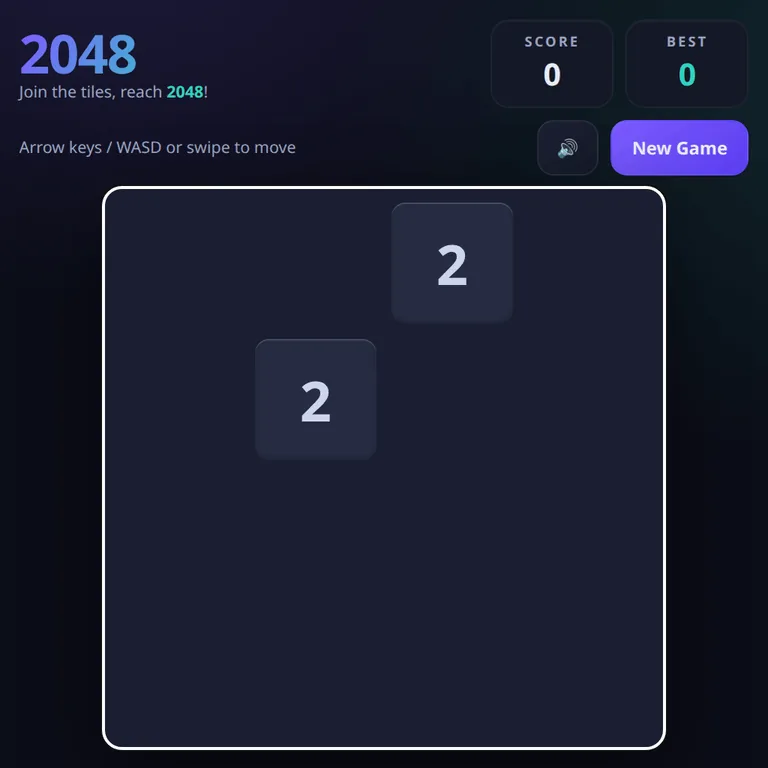
The rules of 2048
The game uses a 4×4 board. Every arrow-key press or swipe moves all tiles as far as they can travel in that direction. When two tiles with the same value meet, they merge into one tile with double the value. A new 2 or 4 appears after each successful move.
Your immediate goal is to create a tile worth 2048. The run ends only when the board is full and no adjacent equal tiles can merge, so empty squares are as important as the score.
Use one corner as your anchor
Choose a corner and treat it as the permanent home of your largest tile. For example, if you choose the bottom-right corner, most moves should be Down or Right. This pushes large values toward one predictable location instead of scattering them across the board.
The anchor works because large tiles become difficult to move around each other. Keeping them ordered along one edge lets smaller tiles feed into the chain without trapping the board.
- Keep the largest tile in the anchor corner.
- Place the second-largest tile beside it on the same edge.
- Build a descending sequence away from the corner.
Build a monotonic edge
A strong bottom row might read 512, 256, 128, 64 from left to right, with the largest tile in your chosen corner. This descending shape is often called a monotonic row. Each value has a natural merge path toward the anchor.
Do not wait for a perfect sequence before making progress. The practical goal is to keep the largest values ordered while allowing the upper rows to generate pairs. Merge those pairs downward only when they fit the edge.
Why the forbidden direction matters
A corner plan normally gives you two safe directions, one occasional recovery direction, and one dangerous direction. With a bottom-right anchor, Up is dangerous because it pulls the entire structure away from the bottom edge. Use it only when Down, Left, and Right provide no productive move and you already know how the anchor will return.
Before every recovery move, check whether a new tile could spawn beneath your largest tile. If that happens, the anchor can no longer slide directly back into place.
Manage empty squares, not just merges
A merge is useful because it increases value and frees a square. A move that creates one merge but breaks three future pairs may still make the position worse. Try to keep at least four empty squares during the middle game so an awkward spawn does not force a panic move.
When the board becomes crowded, slow down. Scan for small pairs first, then trace where the merged tile will land. In Arcadely’s version, a tile can merge only once during a single move, so plan the following move too.
Common 2048 mistakes
Most failed runs come from losing the anchor, creating two large tiles on opposite sides, or swiping quickly without checking the new spawn. Another common mistake is forcing every available merge immediately. Sometimes two separate 16 tiles are more useful than one 32 if they preserve the order of your edge.
- Do not alternate all four directions without a board plan.
- Do not bury a small tile between two large values.
- Do not move immediately after a spawn; reassess the whole board.
- Do not chase score at the cost of the final empty square.
Common questions
Is every 2048 game winnable?
Random tile spawns mean no simple sequence guarantees a win, but disciplined board structure makes reaching 2048 far more consistent than random swiping.
Which corner is best in 2048?
Any corner can work. Choose the corner that feels natural for your controls and keep the largest tile there consistently.
Can I continue after making 2048?
Yes. Arcadely lets you continue the same board after reaching 2048 so you can pursue larger tiles and a higher score.